Understanding Cloud-Native
A Blueprint for Scalable, Agile Applications

I am a DevOps Engineer currently working as a Sr. Platform Engineer at Leegality. My core skills include Containerization and its Orchestration, Implementing Infrastructure as Code for cloud platforms and enabling the process of CI CD. I also have experience with going cloud-native for microservices and setting up observability over Production for better insights.
Journey Before Cloud
The journey of infrastructure access has evolved dramatically. In the past, acquiring infrastructure was a cumbersome process, heavily influencing how applications were designed and developed. This often led to challenges in scaling applications and managing them across different environments. However, with the advent of public clouds like AWS, Azure, and GCP, these hurdles have been largely overcome.
Going Cloud-native
The concept of cloud-native applications was initially discussed in 2013, when Netflix presented their innovative web-scale application architecture at the AWS Re:invent. This pioneering discussion highlighted a transformative approach to building applications designed specifically for the cloud environment.
Cloud-native architecture offers a blueprint for creating web-scale applications that are both highly available and scalable. It promises to enhance agility, enabling organizations to ship new features more frequently and quickly without compromising availability. This increased agility is crucial for responding swiftly to changes in customer demands, providing a competitive edge in today's fast-paced market.
How Cloud-Native Differs from Cloud Computing
While cloud computing and cloud-native may sound similar, they represent distinct paradigms.
Cloud computing involves running applications on compute resources managed by cloud providers. This model relieves organizations of the responsibility of purchasing and managing their own on-premise hardware. Migrating a monolithic application from an on-premise environment to the cloud is a significant step towards implementing cloud computing. However, this migration alone does not make an application cloud-native.
Cloud-native applications are built specifically to leverage the advantages of the cloud environment. They are designed to be resilient, scalable, and able to adapt quickly to changing demands. Unlike traditional applications that are simply transferred to a cloud infrastructure, cloud-native applications are architected to utilize the full potential of cloud services, which includes following a microservice architecture, containerization of application and deployment automation. These fundamental difference allows cloud-native applications to achieve levels of performance, flexibility, and efficiency that traditional cloud computing applications may struggle to match.
Key Differences:
Cloud Computing:
Running applications on cloud-managed resources
Reduces the need for on-premise hardware
Suitable for migrating existing monolithic applications
Cloud-Native:
Built specifically for the cloud environment
Designed for high availability and scalability
Enables frequent and rapid deployment of new features
Utilizes cloud services like automation, containerization, and microservices
Features of Cloud-Native Applications:
Application Architecture:
- Cloud-native applications consist of multiple small, interdependent services known as microservices. These microservices are loosely coupled and communicate via well-defined APIs. This architecture is more flexible and scalable compared to traditional monolithic applications.
Containers and Orchestration:
- Unlike monolithic applications, cloud-native applications can be easily packaged and containerized. Containers are lightweight and contain everything required to run a microservice in any environment. Orchestration tools manage large numbers of containers, ensuring that all microservices run smoothly and efficiently.
Development Process:
- The microservice architecture of cloud-native applications necessitates a process for developing, deploying, and scaling these microservices independently. This requires close collaboration between development and operations teams, leading to the adoption of DevOps practices. DevOps facilitates automation of the development and deployment process through Continuous Integration (CI) and Continuous Deployment (CD). CI involves regularly merging code changes into a shared repository and running automated build and test processes to ensure code quality. CD automates the deployment of tested code to production environments, enabling faster and more reliable releases.
The Core Principles of Cloud-Native Applications
Cloud-native applications follows a certain set of core principles that differentiate them from traditional applications. These principles are essential for maximizing the benefits of the cloud environment.
Design for Automation:
As spinning up infrastructure now is just a few clicks away over cloud console, we need to design our architecture with automation in place.
Automation should be considered throughout the application's lifecycle, including development, deployment, and scaling. We should select tools and services that facilitate automation across these phases.
We can utilize Infrastructure as Code (IAC) and Continuous Integration/Continuous Deployment (CICD) pipelines for achieving automation.
Benefits:
Reduces manual errors
Increases consistency
Accelerates development
Speeds up the deployment process
Design Components to be Stateless:
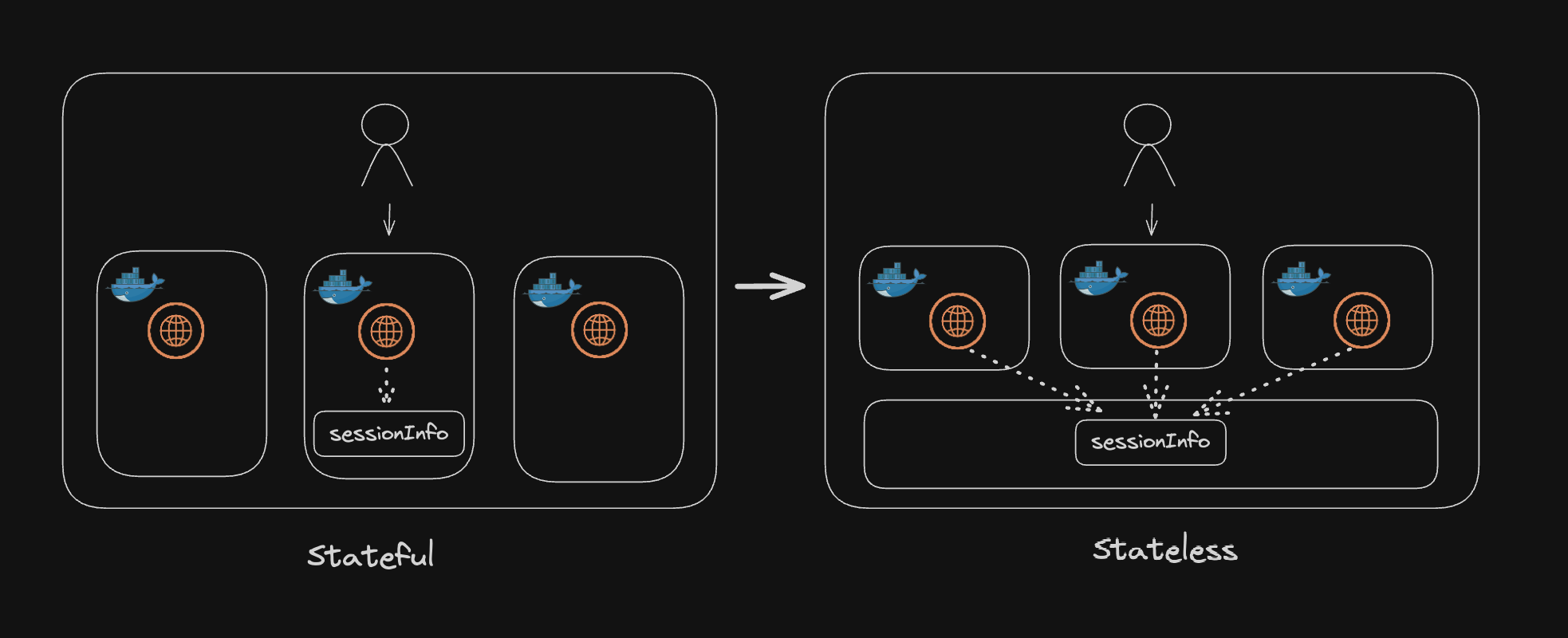
Earlier due to the infrastructure challanges, we never imagined of running multiple instances of same application (Horizontal scaling), and even if we apply this, often relying on sticky sessions where load balancers needed to track which instance was serving a user's request.
The shift from monoliths to microservices necessitates designing applications to be stateless
Benefits:
Enhances fault tolerance
Improves resilience
Facilitates scalability
Favor Managed Services:
Previously, setting up servers, installing necessary software, and configuring networks were time-consuming tasks. Cloud providers now offer managed services, allowing developers to focus on core development rather than infrastructure setup.
Managed Services can include databases, message queues, machine learning models etc.
For eg: earlier, spinning up a DB requires certain steps including server creation, then installing compatible OS, configuring network and security, then installing pre-requisites, finally. setting up the database. And that's not all. Post installation we need to monitor and expand disk space as per requirements and needs to take care of patches and maintenance activity. Now with managed services, all these overhead tasks are eliminated.
Benefits:
Saves time and resources
Improves scalability and reliability
Enhances security and compliance
Practice Defense in Depth:
Security is paramount in the cloud. It's essential to protect against both external and internal threats. This principal not only suggest to have security in place, but also advocates that a multi-layered security policy is implemented.
Multi-layered security suggests that multiple security measures should be taken into consideration at various levels of application by having Firewall, Intrusion detection system (IDS), Access Control (ACL), Virtual Private Network (VPN), Encryption, Antivirus in place.
Why?: Multiple layers ensure that even if one layer is breached, others remain to protect the application and data.
Example: In a multi-tier application, we can have Firewall at network level, Authentication and validation at application level and Encryption and Access control at Database level. This way we can have multi-layered security in place securing application at multiple levels.
Always Be Architecting:
"If it's not broken, don't fix it" doesn't apply in a cloud-native world. The pace of change in cloud-native architecture is rapid, with new tools and technologies constantly emerging. It's crucial to continuously monitor and optimize the application's architecture.
Benefits:
Stay competitive in a fast-evolving environment
Ensure an up-to-date environment
Meet customer needs efficiently
Adhering 12-Factor App Principles:
Cloud-native applications often adhere to the 12-Factor App methodology, which provides a set of best practices for building modern, scalable, and maintainable applications. These principles include:
Codebase: One codebase tracked in version control, many deploys to ensure consistency and versioning.
Dependencies: Explicitly declare and isolate dependencies.
Config: Store config in the environment to keep it separate from code.
Backing Services: Treat backing services as attached resources which simplifies external services.
Build, Release, Run: Strictly separate build and run stages to enhance deployment consistency.
Processes: Execute the app as one or more stateless processes to promote scalability and resilience.
Port Binding: Export services via port binding.
Concurrency: Scale out via the process model to support horizontal scaling as well.
Disposability: Maximize robustness with fast startup and graceful shutdown.
Dev/Prod Parity: Keep development, staging, and production as similar as possible which helps reducing deployment issues.
Logs: Treat logs as event streams for enhanced monitoring and troubleshooting.
Admin Processes: Run admin/management tasks as one-off processes.
In summary, while cloud computing provides a robust foundation by removing the burden of hardware management, cloud-native architecture takes it a step further. It harnesses the full power of the cloud to create cloud-native applications that are robust, scalable, and secured that are well-suited to the dynamic nature of modern cloud environments and are inherently more agile, scalable, and resilient, positioning organizations to better meet evolving customer needs and market dynamics.


